
Design & Development of Smart & Connected Wine Barrel Monitoring System for Industrial IoT Solutions Provider
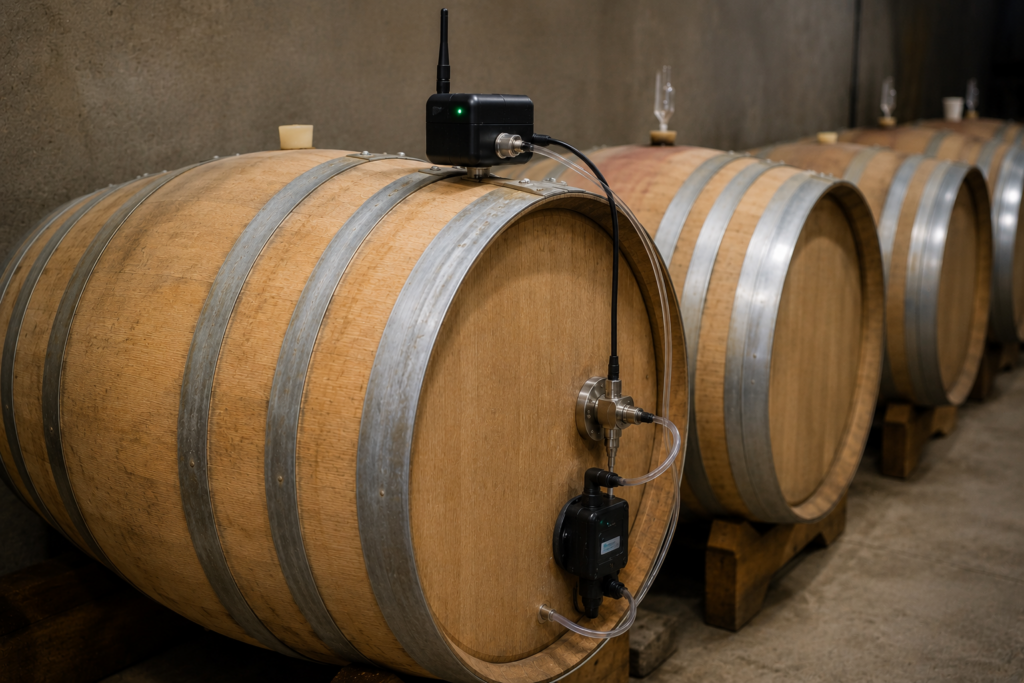
Intelligent wine barrel monitoring and automated ullage control

Client
Vineyard operators Industrial cellar facilities
Industry
Wine Manufacturing Food & Beverage
Solution
Embedded system development
IoT monitoring platform
Use Case
Wine barrel monitoring
Remote cellar monitoring
Technology
IoT Connectivity
Sensor Fusion
Goal
Design and deploy a non-invasive monitoring system capable of continuously measuring barrel conditions and maintaining wine quality without opening the barrel. The objective is to enable real-time visibility into storage conditions, improve preservation accuracy, reduce manual intervention, and automate refill operations across wine cellar environments.
Problem Statement
Wine aging and storage require precise control of environmental conditions inside sealed barrels. Traditional monitoring methods often depend on manual inspection and periodic barrel opening, which increases the risk of oxidation, impacts product quality, and introduces operational inefficiencies.
Maintaining accurate ullage levels and preserving optimal SO₂ concentration are critical for ensuring wine stability and consistency. Existing approaches lack continuous visibility, automation, and reliable data collection, making it difficult to manage multiple barrels efficiently at scale.
Solution Highlights
A connected embedded monitoring and control solution designed for real-time wine barrel management and preservation:
Non-Intrusive Barrel Monitoring
Uses integrated environmental and pressure sensing to continuously monitor internal barrel conditions without opening or disturbing the storage process
Intelligent Ullage Estimation
Applies pressure and environmental data models to estimate ullage volume and detect when refill actions are required to maintain preservation conditions
Advanced SO₂ Measurement
Combines environmental sensing with an optical absorption-based measurement approach using a dedicated sensor module to improve SO₂ monitoring accuracy
Automated Refill Control
Triggers controlled wine replenishment automatically through a sealed refill mechanism when predefined thresholds are exceeded
Embedded Sensor Fusion Architecture
Integrates multiple sensing modules through UART and SPI communication for synchronized data acquisition and coordinated decision making
Cloud Connected Monitoring
Streams operational and environmental data to cloud platforms for remote visibility, event logging, and proactive alert generation
Low Power Embedded Design
Implements dynamic power management and efficient subsystem control to support battery-operated deployment and extended field operation
Reliability and Safe Operation
Use sealed-condition verification, power isolation strategies, and robust protection mechanisms to ensure stable operation in cellar environments
Conclusion
The solution delivers a scalable embedded and IoT-enabled monitoring platform that improves wine preservation, reduces manual handling, and enables intelligent cellar operations. By combining environmental sensing, optical analysis, automated refill control, and cloud connectivity, the system enhances product quality while increasing operational efficiency and reducing risk during long-term storage.