
AI-Powered Visual Inspection for Manufacturing
Edge AI–Enabled Automated Quality Inspection

Client
Leading Ball-Bearing Manufacturer
Industry
Manufacturing
Industrial Automation
Solution
Edge AI
Computer Vision
Use Case
Visual Inspection
Defect Detection
Technology
YOLOv8
Edge AI
Goal
A leading ball-bearing manufacturer in India required a faster and more consistent approach to quality inspection, with image processing performed directly at the production edge.
Vedya Labs was tasked with developing an AI-based visual inspection solution capable of identifying defects and anomalies in real time, reducing dependence on manual inspection and enabling faster quality-related decisions.
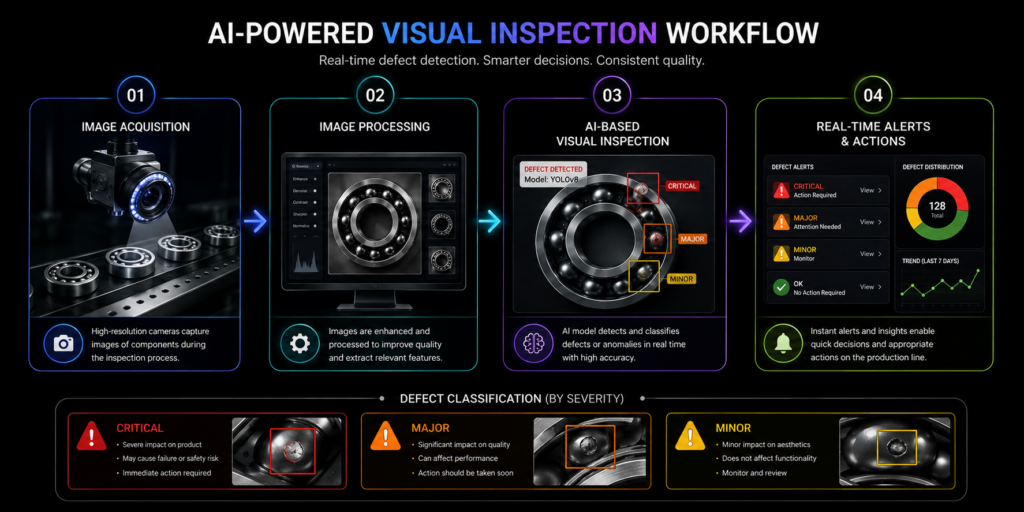
The solution focused on creating an end-to-end inspection workflow covering image acquisition, image processing, AI-based defect detection, and real-time alerts and actions.
Problem Statement
The existing quality inspection process required a reliable way to identify defects across manufactured components while maintaining consistent inspection standards.
As inspection requirements increased, the need emerged for:
- Faster identification of defective components
- Consistent detection across inspection cycles
- Automated identification of defects and acceptable components
- Real-time processing close to the production environment
- Clear classification of detected anomalies
- A deployable solution capable of operating on embedded hardware
- The requirement was to bring AI into the inspection process while keeping the complete analysis close to the manufacturing environment.
Solution Highlights
Vedya Labs developed an AI-enabled visual inspection solution combining cameras, sensors, a custom computer vision model, and edge computing for real-time quality analysis.
Image Capture to Inspection
Cameras capture images of the component during the inspection process. The acquired images are then processed by the vision pipeline before being passed to the AI model for analysis.
Custom AI-Based Defect Detection
A custom model based on YOLOv8 was developed for visual inspection. The model was trained to distinguish defective and non-defective components and identify specific defect categories.
The supporting model validation included classes such as Crack, Edge, Hole, Defect, and OK, enabling the system to locate and classify inspection findings within the captured image.
Edge-Based Processing
The complete inspection solution was implemented on an embedded platform with 20 TOPS of compute capability, allowing AI inference to take place at the edge.
This enables inspection data to be analysed close to the manufacturing process rather than relying on remote processing for every inspection decision.
Real-Time Quality Decisions
Detected anomalies can be categorized according to their severity, including minor, major, or critical classifications. This provides a structured basis for subsequent quality actions and helps maintain consistent inspection standards.
Edge Model Deployment
For embedded deployment, the YOLO model was converted from YOLOv8n to ONNX, followed by model quantization, compilation, and automated pipeline generation.
The resulting MPK package was then deployed onto the Sima development platform, enabling the trained vision model to operate within the target edge environment.
Performance Achieved
The model development and validation demonstrated the following results:
- 100 Epochs — Model training completed in 5.518 hours
- 3.0M Parameters — Custom model with 3,006,623 parameters
- 8.1 GFLOPS — Model computational complexity reported during validation
- ~85.4% mAP50 — Overall mAP50 achieved across the evaluated classes
- 57.5 ms Inference — Reported inference time per image during model validation
- 20 TOPS Edge Platform — Complete inspection solution deployed on an embedded compute platform
The deployment workflow also demonstrated conversion of the trained model into an edge-deployable format and integration with the Sima development environment.
Conclusion
Vedya Labs transformed the visual inspection workflow into an AI-driven edge quality inspection system that combines image acquisition, computer vision, embedded AI processing, and real-time quality actions.
The solution enables automated identification of defects and acceptable components while bringing inference closer to the manufacturing environment. By combining a custom YOLOv8-based model with embedded deployment, the approach provides a foundation for faster, more consistent, and scalable visual quality inspection in manufacturing.