
Visual AI-Based Inventory Tracking For a Laundromat Operator
Edge AI based garment tracking


Client
Laundromat operators Laundry service chains
Industry
Laundry Services Retail Services
Service
Garment tracking AI-based verification
Use Case
Loss Prevention Process Transparency
Technology
Visual AI Edge Computing
Goal
Design and deploy an AI powered system capable of accurately tracking and verifying garments across the entire wash and fold workflow. The objective is to enable end to end visibility, reduce manual intervention, and ensure consistent and reliable operations in high volume laundromat environments.
Problem Statement
Wash and fold laundromats process thousands of garments daily, making manual tracking methods inefficient and error prone. Traditional approaches such as manual counting or tagging often fail to maintain accuracy, leading to misplaced or lost items, inconsistent service across locations, and frequent customer disputes. Additionally, the dynamic nature of garments changing shape during handling and the use of surveillance cameras introduce challenges in accurate detection and classification.
Solution Highlights
A real-time Visual AI–based garment verification system that ensures end-to-end tracking and accuracy
Automated Garment Detection
End-to-End Verification
AI-Powered Accuracy
Real-Time Performance
Visual Evidence Tracking
Scalable Deployment
Conclusion
Short Summary
Wash and fold laundromats, which process huge garment volumes daily, lost, misplaced or damaged clothes often result in costly disputes and unhappy customers. Refund policies usually cap compensation, leaving customers dissatisfied. This case study explores how a Visual AI solution improves customer experience by ensuring garments are tracked transparently and reliably throughout the laundry process.
Industry Background
Our client operates in the wash and fold laundromat sector, an industry expanding rapidly as customers look for convenient and dependable garment care. With thousands of items processed each day, operators must maintain consistent service quality to meet rising customer expectations.
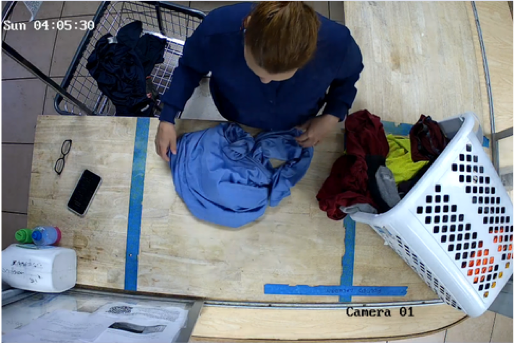
As the sector adopts AI and digital tools to modernize operations, wash and fold businesses aim to deliver a strong customer experience built on three essentials:
- Speed – fast turnaround
- Precision – every garment handled correctly
- Reliability – assurance that items will not go missing
Customer Challenges and Goals
Challenges
- Lost or misplaced garments: Even one missing shirt or suit can cause frustration and loss of trust.
- Manual errors: The traditional method of noting clothes on paper or attaching small labels to them often fails, causing confusion about what the customer actually handed over or received.
- Inconsistent service across sites: Personnel behaviour led to inconsistent accuracy.
- Disputes and capped refunds: Compensation limits often left customers dissatisfied despite genuine mistakes.
Goals
- Transparency and trust: Proof that every garment handed over is tracked end to end.
- Accountability: Automated verification of before and after wash garment counts.
- Assurance: Reduced anxiety over lost items or service disputes.
- Consistency: Uniform reliability across all service centres.
Solution and Implementation
To meet these expectations, Vedya Labs developed a real time AI powered garment verification system designed for wash and fold laundromats. The solution integrates off the shelf IP cameras with the NVIDIA based edge AI compute to automatically detect and verify garments during the before wash and after wash stages.
The system performs on site visual analytics to identify every garment received, along with visual evidence that can be used for human verification when needed. It validates the garments again during the delivery stage to ensure that the same items, in the correct quantity and type, are returned to the customer. This visual evidence based approach provides complete transparency and future proofing for both the wash and fold operator and the customer. It also removes the need for manual records or remote servers, enabling fast and private processing.
Challenges
- One of the main problems encountered against the standard Visual AI based use cases is that the object shape is changing continuously in the wash and fold laundromat case. As the garments are taken out of the bag and the unfolding and folding process happens, the shape of the garment keeps changing. This creates challenges in identifying the cloth type.
- The second challenge is that when we provide our solution to the operators, it should not change the process they already follow too much, because any significant modification would affect their productivity and convenience.
- The third challenge is related to solution cost and convenience, which requires the use of surveillance-grade cameras. These cameras often produce images with compression artifacts, especially during high motion when the operator is unfolding or folding the clothes.
Solution design
To overcome the above three challenges, Vedya devised a three-stage process
1) Identifying one unique piece of garment, which is treated as a transaction.
2) Within each transaction, which may take varied amounts of time, identifying the key frame that can be used to determine the garment type. Performing garment type detection on the selected key frame, which is necessary to get an accurate result from surveillance grade video.
3) Utilizing a cloud based LLM model to cross validate the garment type against the edge AI based model detection in order to improve the overall accuracy.
Development
Data was collected across multiple laundromats to capture diverse environments, camera setups, lighting conditions, backgrounds, and garment variations. Over a period of 2 months, a total of 90,000 valid frames were captured. This diversified dataset helps ensure that the cloth detection and classification models generalize well across real-world laundromat conditions.
Annotation
All collected frames were annotated using the CVAT tool.
Each garment was labelled with a rectangular bounding box, and garment types were tagged as part of the annotation process.
Frame Rates
The two datasets follow different capture speeds based on real operations:
• Before Wash (BW) Dataset: 25 fps (fast-paced operation)
• After Wash (AW) Dataset: 5 fps (slow-paced operation)
Infrastructure
Model development—including training, evaluation, and inference—was carried out on an NVIDIA
RTX 4080 GPU.
Preprocessing
Images were captured at 1920×1080 resolution and scaled down to 640×360 to reduce computational complexity while preserving sufficient detail for detection and classification tasks.
Model Architecture
- YOLOv11s–based pose estimation model: Used for tracking human movement and cloth handling actions.
- YOLOv11s–based garment/garment-type detection model: Trained on the collected dataset for cloth detection and type identification.
- Custom logic: Key-frame selection and cloth-type classification leveraging detection frequency and area coverage. Key frames are further processed using Gemini API for classification.
Post-Processing
Outputs from the pose estimation and garment detection models are fused to achieve:
- Transaction detection
- Key-frame identification for accurate garment-type classification
Optimization
Building a cost effective AI solution is a daunting task. AI application running multiple models along with evidence video recording, cloud interaction and ensuring the every frame is processed within stipulated time is critical to get the best analytics. Initial solution pipeline without any optimizations performed the solution at 3 fps performance only and it is not sufficient for real time applications. To improve the real time performance within Nvidia Jetson Orin NX following optimizations are performed at multiple levels and achieved 50 frames per second.
System-Level Optimization
- Single scaling operation reused across multiple models
- Multi-threaded solution pipeline
- Evidence storage optimization
- Evidence video encoding optimization pipeline improvements
- Reduced overhead in cloud API interactions
Model-Level Optimization
- Quantization to INT8/FP16 for faster inference
- Mixed-precision execution to preserve near-FP32 accuracy
- Conversion of PyTorch models (.pt) to TensorRT engine for CUDA-optimized real-time performance
Framework-Level Optimization
- PyTorch used for experimentation
- TensorRT used for deployment to maximize inference speed
OS-Level Optimization
Since the system is not active 24×7, switching between:
- High-performance mode during operation
- Balanced/low-power mode during idle periods
- helps maintain real-time performance and system reliability.
Accuracy Results
- Before Wash (BW) dataset: 88% accuracy
- After Wash (AW) dataset: 93% accuracy
Process Flow (Customer Journey)
- As customer drops off the clothes at laundromat in a sealed bag
- Bag will be picked up for washing and operator will open the bag and do the inspection of each cloth for any rough stains etc.
- This process will be happened on prescribed table which is covered through the camera view.
- Before Wash Detection – As the operator triggers the activity on the Mobile application and enters the Transaction ID, visual AI pipeline will activate and provides the number of garments and each garment type as explained in the above solution section.
- After Wash Verification – After washing, operator brings the clothes from dryer to folding area, operator triggers the application and enters the same transaction ID as entered in before wash process. Visual AI pipeline will detect the number of garments, type of garments and validate the count and type with the before wash results.
- Operator will have a provision to over-write the visual AI outcomes if he finds any discrepancies.
- Once the after wash package is completed and validated, a pickup notification will be sent to customer.
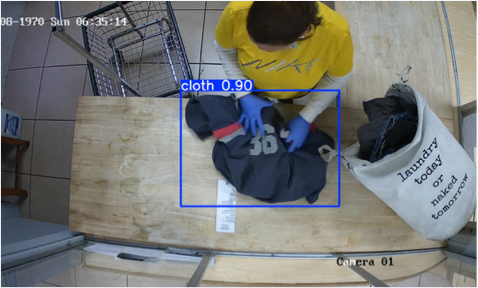
Before Wash
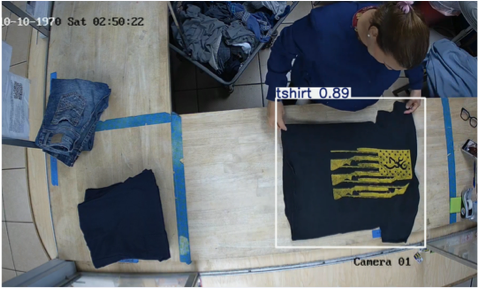
After Wash
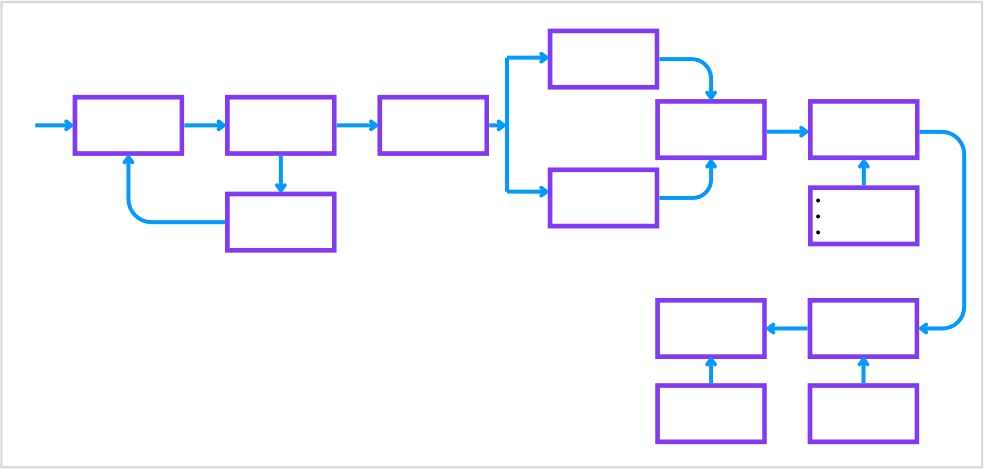
Solution Architecture
Snippets of Loss Prevention Solution 10080




Value Delivered
The solution delivers complete transparency and reliability across the wash and fold workflow by digitally tracking every garment with visual evidence. Its real time processing ensures fast detection, low latency alerts, and consistent performance across all locations. With on device computing and optimized AI models, the system offers high accuracy, minimal errors, and secure handling of customer data. It is also cost effective to deploy at scale, making it suitable for large laundromat networks.
In operation, the system has significantly improved customer confidence by providing clear proof of garment handling and enabling quicker resolution of issues. Pilot sites reported zero garment disputes, lower refund related costs, and marked improvements in customer satisfaction. By elevating accuracy and trust while reducing operational effort, the solution sets a new benchmark for dependable and efficient wash and fold services.