
What Is Physical AI? A Complete Guide to Intelligent Systems and Real-World Applications
Understand what Physical AI is, how it works, the technologies behind it, and how it enables intelligent systems to interact with the physical world.
Published On : 22/09/2026 | 15 Min Read

Introduction
Imagine a robot identifying a bottle on a desk, navigating through an office, avoiding obstacles, picking it up, and delivering it to the right location without human intervention. To perform these tasks, the robot must perceive its surroundings, understand what it sees, make decisions, and interact safely with the physical world.
This capability is made possible by Physical AI. By combining perception, embedded computing, Edge AI, robotics, and intelligent control systems, Physical AI enables machines to sense, reason, and act autonomously in real-world environments.
As industries increasingly invest in intelligent automation, Physical AI is emerging as a foundational technology powering the next generation of robots, autonomous systems, and smart industrial solutions.
What Is Physical AI?
Physical AI refers to intelligent systems that can perceive their surroundings, process information, make decisions, and perform actions in the physical world.
Unlike traditional software-based AI that analyzes digital information, Physical AI combines sensors, embedded computing, perception models, and control systems to interact with real environments.
Why Physical AI Matters
Traditional automation systems are designed to perform predefined tasks in controlled environments. While effective for repetitive operations, they often struggle when conditions change unexpectedly, such as variations in lighting, object placement, or human interaction. Physical AI overcomes these limitations by enabling machines to perceive their surroundings, make intelligent decisions, and adapt to dynamic real-world environments.
Physical AI helps organizations:
- Understand complex and changing environments
- Make intelligent decisions in real time
- Improve operational efficiency and productivity
- Reduce manual intervention and human error
- Adapt to dynamic situations with greater autonomy
For industries such as manufacturing, logistics, healthcare, and semiconductor production, these capabilities enable more intelligent automation, improved operational resilience, and faster decision-making.
Core Technologies Behind Physical AI
A Physical AI system typically consists of several interconnected technologies.
1. Sensors
Sensors collect information from the environment, including images, audio signals, distance measurements, temperature, motion, and other physical parameters.
2. Perception
Perception systems interpret sensor data to identify objects, understand surroundings, and recognize events.
Examples include:
- Computer vision
- Audio intelligence
- Object detection
- Spatial awareness
Edge AI enables real-time processing closer to the source of data generation, reducing latency and minimizing cloud dependency.
Embedded platforms provide the computing foundation that connects sensors, AI models, and control systems.
5. Control and Actuation
Based on AI-driven decisions, control systems execute physical actions through motors, robotic arms, actuators, or other mechanical components.
Physical AI Workflow
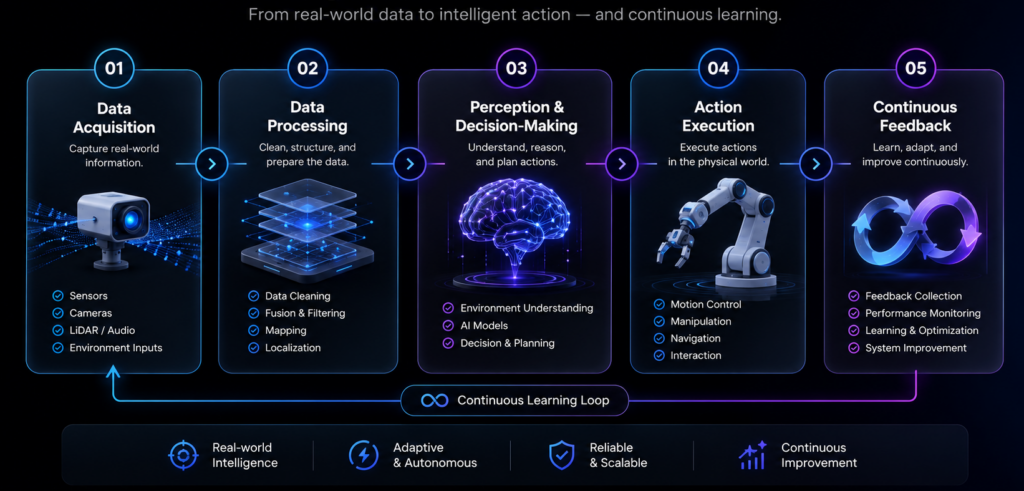
Training Physical AI Systems
1. Simulation and Virtual Testing
Engineers first create a virtual environment where a robot can safely perform tasks before real-world deployment. For example, a pick-and-place robot can be tested in a simulated office to evaluate navigation, obstacle avoidance, and object handling under different conditions. This allows developers to validate system behavior without risking physical hardware.
2. Synthetic Data for AI Training
3. Reinforcement Learning and Continuous Improvement
Real-World Applications of Physical AI
Manufacturing
Robotics
Semiconductor Industry
Warehousing and Logistics
Smart Infrastructure
Engineering Challenges
- Real-Time Performance
- Sensor Fusion
- Power Efficiency
- Scalability
- Safety and Reliability
Vedya's Perspective
At Vedya Labs, we provide AI technology and engineering solutions across Physical AI and Enterprise AI, helping organizations turn AI capabilities into practical, production-ready systems. Our engineering expertise spans perception, Edge AI, embedded software, AI model optimization, sensor pipelines, robotics, system integration, and enterprise AI applications.
As part of our growing focus on Physical AI, we have developed a pick-and-place robot that brings several of these capabilities together in a real-world system. The robot combines perception, sensor processing, AI, embedded computing, navigation, and robotic control to understand its indoor environment, identify objects, navigate, and perform physical tasks.
This hands-on experience gives us practical insight into the engineering challenges involved in connecting AI software, embedded systems, and physical hardware to build intelligent systems for real-world environments.
The Future of Physical AI
Physical AI brings together perception, intelligence, and real-world action to enable machines that can understand their environment and respond autonomously. By combining technologies such as sensors, embedded systems, Edge AI, and robotics, organizations can develop intelligent systems that solve complex real-world challenges across industries.
As technology continues to mature, understanding the core principles of Physical AI will be essential for businesses looking to build scalable, reliable, and production-ready intelligent solutions.
Conclusion
Physical AI is rapidly evolving from research and prototypes to real-world deployment across industries. Advances in perception, robotics, Edge AI, embedded systems, simulation, and foundation AI models are enabling intelligent systems to operate with greater autonomy, efficiency, and adaptability.
As organizations continue to invest in intelligent automation, Physical AI will play a key role in powering the next generation of robots, autonomous machines, and smart industrial systems. The convergence of AI and physical systems is set to redefine how machines perceive, decide, and act in the real world.